

Marcus had always considered himself a reasonable man. He recycled. He flossed. He had, at various points in his adult life, created a budget spreadsheet. None of this had prevented him from spending $847 on a pasta maker, two weighted blankets, a pricy “professional-grade” knife set he used exclusively to open Amazon boxes, and something called a “posture corrector” that now lived under his bed like a plastic ghost of good but frittered intentions.
So when his therapist suggested he look into dopamine sites, he was skeptical in the way of a person who’d heard a lot of bad ideas delivered with great confidence.
“It’s a fake online store,” Dr. Yuzna explained. “You browse, you add things to your cart, you even check out. But nothing arrives. No charge to your card. You get the neurological hit without the consequence.”
Marcus stared at her. “So it’s shopping, but for ghosts.”
“It’s a behavioral intervention.”
“Sure,” he said. “That.”
He downloaded the app that night, mostly to prove it wouldn’t work. The interface was immaculate: clean sans-serif fonts, aspirational lifestyle photography, the kind of product descriptions that used words like artisanal and intentional without apparent irony. He added a $340 standing desk converter to his cart. Then a sous vide circulator. Then a linen duvet with a thread count high enough to have its own area code.
He checked out at midnight with $1,200 worth of items he did not need and would not receive.
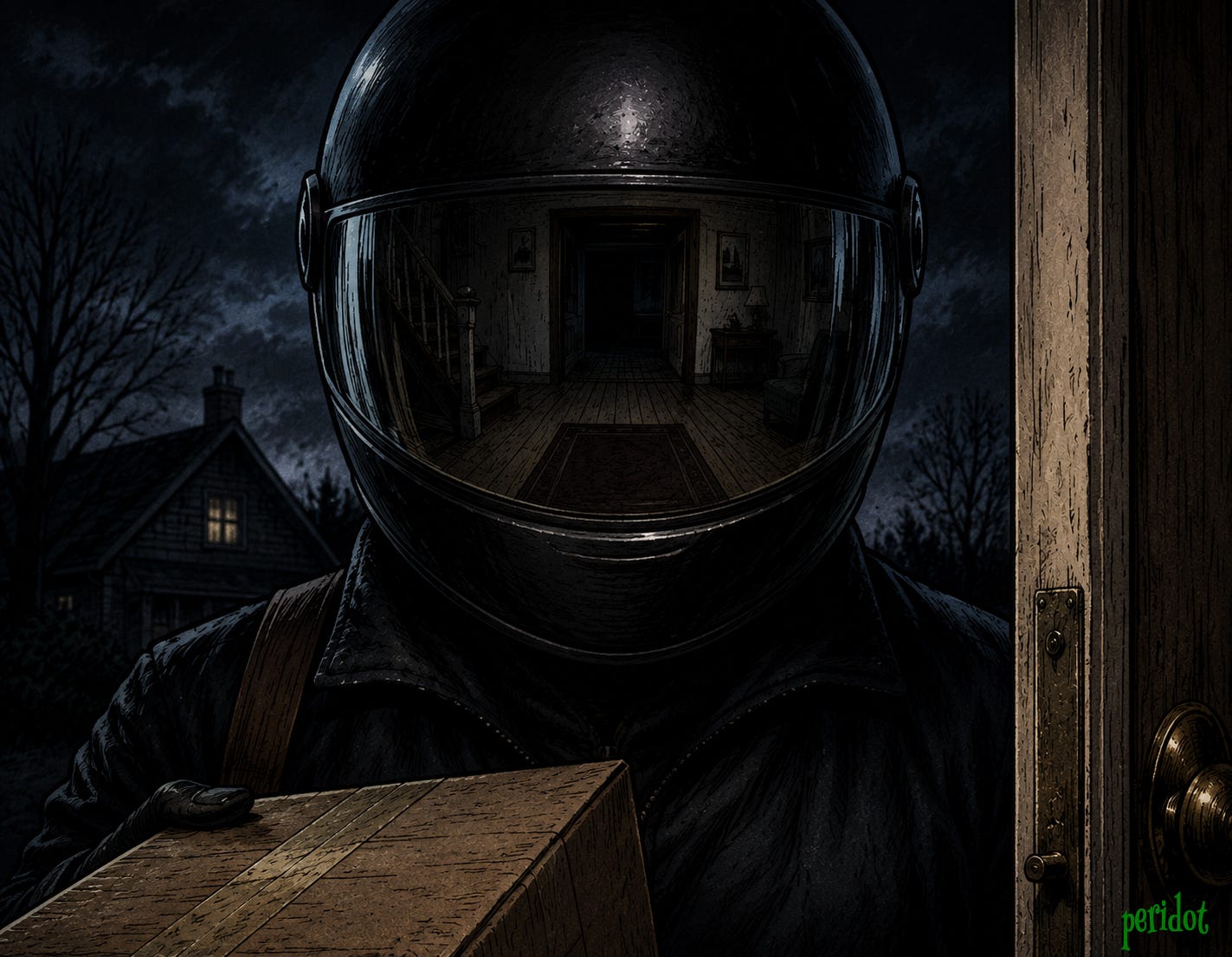
A courier appeared on his tracking map almost immediately. Little motorcycle icon. Clean route. ETA: never, presumably, given the metaphysical nature of the transaction.
Marcus went to sleep feeling faintly ridiculous and, he had to admit, weirdly fine.
= = =
The box arrived the next day.
It was unremarkable as boxes go: brown cardboard, standard tape, his name and address printed on a label in the particular font of low-budget logistics. He stood in his doorway holding it for a full thirty seconds before carrying it inside with the careful movements of a man who suspects he may be hallucinating.
Inside: the standing desk converter. Bubble-wrapped. Complete with a small card that read, Thank you for your order. We hope this exceeds your expectations.
Marcus called the dopamine site’s customer service number. He was on hold for four minutes, which is technically fast by the standards of companies that actually exist, and was then greeted by a voice so warm and frictionless it felt like being wrapped in fleece.
“Thank you for calling DopaMart! My name is Brea. How can I support your wellness journey today?”
“You sent me a standing desk converter.”
“Wonderful! How are you enjoying it?”
“I haven’t—it wasn’t supposed to come. Your entire model is based on things not arriving.”
A brief pause. Not a confused pause. More like the pause of someone consulting a script they find mildly amusing. “I’m showing here that your order was fulfilled successfully. Is there anything else I can help you with?”
“I want to return it.”
“Of course! We’d love to make this right. Can I get your delivery address?”
“You already have my delivery address. You sent me the desk.”
“Wonderful,” said Brea. “A courier will be in touch.”
No courier came. The standing desk converter remained on his kitchen table, hoping to improve his posture whether he wanted it to or not.
= = =
The sous vide circulator arrived on Thursday. The duvet on Saturday, which Marcus had to admit was extraordinarily soft, in the way that things you didn’t ask for and cannot explain sometimes are.
He called customer service again. This time, he got someone named Deven, who had the same warm, gliding cadence as Brea and expressed the same cheerful helplessness with the precision of a Swiss watch.
“I want to cancel my account,” Marcus said firmly.
“Absolutely, we totally understand. Can I ask what’s prompting this?”
“You keep sending me things.”
“And how has that made you feel?”
Marcus pulled the phone away from his ear and looked at it the way people do when they need a moment to accept that this is, in fact, their life. “Are you actually asking me how it’s made me feel?”
“We care deeply about your experience.”
“I feel like I’m being haunted by a fulfillment center,” he said.
“That feedback is so valuable. I’m making a note.” A sound of faint, cheerful typing. “Is there anything else we can support you with today?”
= = =
The items that followed did not get stranger, exactly. They got more specific.
A French press in the exact shade of matte green he’d been mentally comparing to other French presses for three years without telling anyone. A record player, entry-level but good, the kind he’d decided at 24 he’d buy “someday,” which had since become the word he used when he meant “never.” A first edition of a novel he’d borrowed from a college girlfriend in 1994, never returned, and thought about with a frequency that probably warranted its own line item on a therapy intake form.
He hadn’t searched for any of these things on the app. He’d ordered a Bluetooth speaker, a cast-iron skillet, and a tension rod for his shower curtain, all the mundane totems of a man managing his habits. What arrived was something else entirely, delivered in unmarked boxes that smelled faintly of cedar and something he couldn’t identify, something that sat in the back of his sinuses like a memory he hadn’t thought of in years. Sulfur?
DopaMart’s customer service remained relentlessly unflappable.
“How did you know about the record player?” he asked Deven, or possibly Brea, or possibly someone else entirely who sounded identical in ways that had stopped feeling like a fluke.
“We just want you to have what you really want,” the voice said, with the unambiguous warmth of something that has never wanted anything at all.
“That’s not an answer.”
“We find that people often already know what they need. We’re just here to help bridge the gap.”
Marcus looked at the record player sitting on his counter, needle resting on a record he didn’t own yet but was increasingly sure would arrive by Friday. “What gap?”
The line was quiet for a moment. When the voice came back, it was still warm. Still frictionless. Still the sound of something very competent performing reassurance.
“The one,” it said, “between what you tell yourself you want and what you actually do.”

= = =
The record arrived on Friday. Side A, Track 1 was a song from the summer of 1991 that he hadn’t heard since an August night in a certain parking lot, and he stood in his kitchen and listened to all four minutes and twelve seconds of it without moving.
He did not call customer service.
He did not try to return anything.
He sat down at his laptop, opened the DopaMart app, and stared at the cart. Empty. Waiting. The cursor blinked at him.
He typed: What are you?
The search bar returned zero results, which he supposed was fair.
He typed: What do you want from me?
A single product populated. No image. No price. No reviews, though the star rating was 4.8 out of 5.
The product name read: To finish what you started.
He added it to his cart.
He checked out at midnight, the same time he always did, because people are nothing if not consistent, which is both their greatest comfort and their most exploitable quality.
The estimated delivery window read: Already in progress.
Outside, a motorcycle engine turned over, and somewhere on a server he would never locate, a cart he had never filled, quietly updated its status to: Delivered.
= = =
StaciLayneWilson.com
WomenInHorror.com
*Thanks to David J. Schow for inspiring this short story. I’d never heard of dopamine shopping (yes, this is a real thing) before he told me about it.
Enjoyably creepy!
Your best short story. You nailed something between what I wanted to read, and what I needed to read, without even speaking to me.