
One, Two, Three, Four (fiction)
The Leprechaun's Con

The leprechaun smelled like old leather and river moss and something that might have been Guinness if Guinness had been brewed underground for several centuries by someone with an abiding grudge. He was sitting on a recycling bin behind the Harp & Hound Irish Pub, Silver Lake, Los Angeles, and he was reading a magazine with the concentrated fury of a man reviewing his own obituary.
Better Gnomes & Gargoyles. March issue. The St. Patrick’s Day spread.
The rag billed itself as “the premier lifestyle publication for the discerning supernatural stylist,” and its special layout, Mythological Creatures in Couture: A St. Patrick’s Day Special, had devoted twelve glossy pages to pixies (six), brownies (two), a gnome who had apparently done something interesting with his kitchen backsplash (three), and one extremely self-satisfied banshee in Padmore & Barnes boots who the editors described as “hauntingly chic,” which the creature on the trash tub considered the single laziest headline in the magazine’s four-hundred-year history.
There was nothing about leprechauns.
Not one blip. Not a single solitary centimeter of editorial space had been given to his kind.
Seamus Og Fionnbarr Devlin pressed his tiny round sunglasses—black-lensed, non-prescription, worn exclusively in homage to Bono—up the bridge of his long, bumpy proboscis and felt something ancient and dangerous kindle in his chest. His coat, bottle-green velvet with brass buttons that caught the parking lot sodium-light like captured coins, did not wrinkle. The coat had dignity. The coat had been tailored in 1887. The coat was handling this better than he was. He gazed at his beautiful leather boots, cobbled himself, with pride. Much better than any old Padmore & Barnes, that was for sure.
Inside the pub, through glass gone amber with kitchen grease, a young woman was singing “Zombie” like she meant it as a personal threat.
He tucked the magazine under his arm and jumped down.
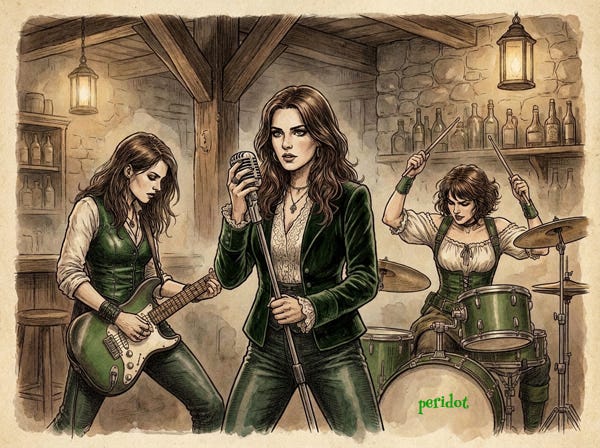
The Keening were twenty minutes into their second set when it happened. Roisin Malone—lead vocals and strong opinions about everything from green beer to the moral character of anyone who owned a Pop CD unironically—was mid-way through “The Boys Are Back in Town” when the lights did three things they shouldn’t. Flickered. Died. Came back smelling warm and mossy.
The leprechaun appeared between Cara and the monitor speaker as if the stage had always contained him and they’d simply failed to notice. Then he opened his mouth and the sound filled the room like pressurized weather.
“YOU STOP THIS TRAVESTY, THIS SONIC CATASTROPHE, AND PLAY U2 OR FACE MY VOCABULARY!”
Moira, behind the drum kit, tapped her snare once. Mouthed at Roisin: Promoter?
Roisin mouthed back: I don’t think so.
The audience carried on as if nothing were amiss.
Cara’s left hand was still on her guitar neck. She could feel the strings humming faintly under her fingertips, like they were nervous. “Did that rhyme?” she whispered.
“Barely,” said Roisin.
“Barely?” small Seamus spat, vibrating like a kettle at full boil. “I rhyme with precision, I rhyme with flair—I've rhymed every insult since the Great Plague year!” And for good measure, he repeated, “YOU STOP THIS TRAVESTY, THIS SONIC CATASTROPHE, AND PLAY U2 OR FACE MY VOCABULARY!”
“No,” Roisin said.
The trio never, ever played U2. It was far too simple, too on-the-nose. No, they played The Cranberries, The Pogues, Sinéad O’Connor, and even threw in the occasional Horslips, just to keep the audience suitably impressed.
Shortly after the band’s refusal of his request, the itty-bitty apparition disappeared in a puff of emerald smoke. The band shrugged, assuming it was just too much of the St. Paddy’s Day spirits, and finished their set with a rousing rendition of The Boomtown Rats’ “Clockwork.”
That was it. First the magazine, and now this uppity cover band. Seamus was in a snit of biblical proportions.
The musicians found the shoes in the greenroom after the set. Three pairs, sitting in a neat line on the bench like small leather diplomats from somewhere you very much did not want to visit. The leather was warm to the touch. Not room-temperature warm, but alive warm. The insides were lined with what felt like velvet, or possibly very finely carded fog. Cara pressed two fingers against the toe of one and immediately felt an odd pull up through her wrist, like the shoe was considering her.
Moira put hers on in about four seconds flat.
The dancing began immediately. Feet flat, arms rigid at her sides, expression the focused neutrality of someone filing quarterly taxes. Then her body executed a rapid-fire Irish step sequence that turned the linoleum into a percussion instrument. Crack-crack-crack-crack, the rhythm perfect and merciless, her face entirely elsewhere.
The smell in the room shifted. That river-and-old-leather scent again, deeper now, threaded with something almost sweet, like turf smoke and a distant rainstorm.
Seamus was back, shining his shoes. Up close, the boots were more than mere footwear. They were black as the held breath of a miner, mirror-polished to a depth that seemed to go in rather than reflect out, stitched in a pattern too fine for human hands. He was polishing the left one with a chamois cloth the size of a cocktail napkin, looking up at them over the rims of his sunglasses with the expression of someone who has been wronged at a cellular level.
He gave an appreciative nod to Moira’s frantic, unstoppable dance, then turned his gaze to Cara.
Cara’s pair was already in her hands. The leather was extraordinary. She could feel the stitching under her thumb like a pulse.
“Don’t,” snapped Roisin.
Cara put them on. Her feet moved. Her face arranged itself into the expression of someone discovering they’ve been enrolled in a class they didn’t choose but are nonetheless quite good at. She grabbed the amp for balance, missed, and rattled through a four-bar reel that knocked over a mic stand and her own dignity in roughly equal measure.
Roisin’s pair sat on the floor between her and her bandmates. She dropped them, kicked them, and then watched, jaw set, as they righted themselves, oriented with the uncanny precision of a cat landing on its feet, and began scuttling toward her sideways on their laces, making a small clicking sound. She grabbed a can of dry shampoo and threw it. The shoes dodged. The can clattered against the wall and released a cloud of synthetic lavender that settled over the scene with cheerful inappropriateness.
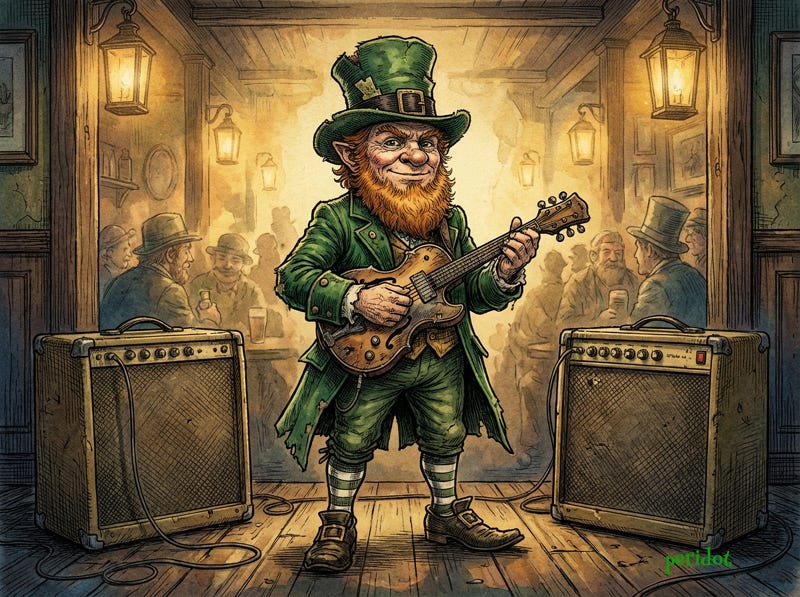
“JUST ONE U2 SONG, LASSIES,” Seamus announced, materializing on the counter, chamois cloth raised like a conductor’s baton. “ONE SONG AND YOUR FEET ARE YOUR OWN, WHAT A FAIR PRICE FOR LEAVING YOU ALONE!”
“That’s debatable,” muttered Roisin, still backing away from the high heels with her name on them.
Then the cellar opened up, revealing a secret the pub had been keeping for decades. The stairs smelled of cold stone and cedar and something mineral, almost metallic, the scent of water that had never seen daylight. The space below was strange in every measurable way... too wide, too tall, the ceiling somewhere up in the dark above them, the walls receding into shelving that held more shoes than any building this size had any way of containing. Centuries of them. The leather and buckle and wood of it all releasing a dense, complex aroma that pressed against the back of the throat.
The Guinness barrels glowed amber in stacked formations, the light pulsing in a slow, irregular rhythm that Roisin’s brain kept insisting was a heartbeat, despite her instructions to the contrary.
The leprechaun’s pot of gold sat on its stone pedestal, as if it had always been there and always would be. The light around it was colder than the barrel-glow—deliberate, directional, the kind of light that watches you back. Strangely, the gold wasn’t in nuggets, but layered in flat shards, like something that had been shattered.
“If you won’t play a U2 tune,” he wheedled, “then at least stay long enough to have a gander at me gold boon.”
Cara’s hand, bobbing as she danced, moved toward it with the specific gravity of someone who knows exactly what they’re doing is wrong and is doing it anyway. She tucked the small pot under one arm, still jigging.
“The gold plays the song,” said Seamus, and his voice had dropped to something that was almost a croon, halfway a moan. “It plays it on a loop, for every year and every moon, and the one who touches it will never leave the tune—just ‘Vertigo,’ forever, spinning round and round the room.” He smoothed the lapel of his coat with one stubby hand. “I’ve listened to it meself, on certain lonesome nights, when the fairy rings go dark and there’s no one left to fight. ‘Tis a fine song, I’ll grant you, a very fine song indeed. But forever is a long time, lassies, and forever’s on the climb.”
He faded away, then disappeared into the ether.
The shoes gave up somewhere around the first-floor landing. They sat down. There was no other way to describe it; the shoes simply stopped moving, settled, and went still. Cara and Moira took off their heels and kicked them away, panting. Cara tried to leave the minute pot of gold behind, but it was stuck to her hand.
Roison heard, from somewhere below, the sound of someone reading aloud from a magazine. The squeaky, angry voice was reciting the letters page. It was the leprechaun who’d tricked them into stealing the enchanted pot of U2’s shattered, broken gold records. He hadn’t gone, after all.
She felt a chill. “Let’s get out of here, quick!”
Outside, the Silver Lake night was doing its normal things: palm trees, passing Ubers, a man on a skateboard. The Harp & Hound’s sign buzzed its ordinary orange buzz. No lingering sulphur. No ambient supernatural resonance. Just Los Angeles being Los Angeles, which was its own kind of uncanny.
“Right,” said Moira, getting into the van. “Back again next week?”
“Next week,” nodded Roisin.

Cara put her seatbelt on, fumbling with the petite pot of gold. She looked out the window at the pub, which sat there looking completely normal, which it most decidedly was not. “Vertigo is actually a good song,” she said, very quietly, to the window.
“Yeah, I guess so,” said Roisin, from the driver’s seat, rolling her eyes.
They drove home through the glittering, indifferent city, and none of them mentioned the fact that when Roisin had started the engine, the first thing that had come on the radio—instantly, loudly, with the cheerful precision of something that had been waiting—was the opening count of “Vertigo.”
Un, dos, tres, catorce!
Roisin turned it off.
The silence had texture. The silence felt like it was counting. Like it was smiling.
Lovely. Let me raise a properly poured Guinness in your direction all the way from NYC.
Man, this is a freaking GREAT story...so funny! I really love this...made my morning! Thanks RPS, and Happy St. Pat's!